A Market in Transition
The Canadian municipal technology market is undergoing significant structural change. Legacy vendors who have dominated the market for two decades are losing ground to modern, cloud-native platforms built for how municipalities need to operate in 2026 and beyond.
This transition is driven by three converging forces: the escalating maintenance costs of aging legacy systems, rising citizen expectations for digital service quality, and the emergence of GovTech platforms that are architecturally different from what came before.
Understanding this transition requires understanding both where the market has been and where it is going.
Across Canada, municipal revenue software is aging while citizen expectations, accessibility legislation and security demands keep rising.
Where the Market Has Been
The municipal technology market in Canada developed in an era of on-premises software, desktop-first design and department-level procurement. Vendors built point solutions for specific municipal functions — property tax, utility billing, building permits — and municipalities assembled these point solutions into operational technology stacks through individual procurement decisions made over time.
The best vendors in this legacy era built excellent software for their specific function. But no vendor built a platform that could unify the full municipal revenue lifecycle. Integration was achieved through nightly file transfers, manual data entry and custom-built connectors that required ongoing maintenance.
This architecture made sense in 2000. Today, it is a strategic liability.
The accumulated technical debt of twenty years of fragmented municipal IT infrastructure is now manifesting as:
- Rising maintenance costs as vendors charge for compatibility updates to aging codebases
- Security vulnerabilities in software that is no longer receiving active security development
- Inability to meet citizen expectations for digital service quality
- Finance staff spending disproportionate time on reconciliation and manual processes
- Leadership unable to get real-time visibility into municipal financial performance
The Legacy Vendor Trap
Many municipalities find themselves locked into legacy vendor ecosystems not because the software serves them well, but because the switching cost appears high. The perceived switching cost rarely accounts for the ongoing cost of staying — maintenance fees, upgrade projects, consultant fees and staff time.
The Forces Driving Modernization
Three forces are simultaneously pushing Canadian municipalities toward platform modernization.
Force 1: Citizen Expectations Have Changed
The digital service experience that citizens now expect from their municipality is shaped by their experience with consumer apps, online banking and e-commerce. They expect to be able to check their account balance, make a payment and submit a request at 11pm from their phone without calling anyone.
Legacy municipal systems cannot deliver this. Most were not designed for web access at all. Those that added web portals as afterthoughts provide a disconnected experience — a separate login, incomplete account information and no mobile optimization.
Municipalities that cannot meet these expectations face increasing citizen frustration and service pressure. Platforms built for digital self-service are designed to lift voluntary payment rates and reduce service call volumes.
Force 2: Regulatory and Reporting Requirements Are Expanding
The regulatory environment for Canadian municipalities is becoming more demanding, not less. Provincial accessibility legislation (AODA in Ontario, equivalent legislation elsewhere) requires accessible digital services. Data privacy legislation requires documented data governance. Audit requirements are becoming more stringent.
Legacy systems were not designed with these requirements in mind. Retrofitting WCAG accessibility onto a system designed in 2005 is expensive and produces poor results. Implementing the data governance Canadian privacy legislation expects on a system with no audit trail is not practical without replacing the system.
Modern platforms like RevoraSphere are built with these requirements as design specifications, not afterthoughts.
Force 3: Cloud Economics Have Shifted
The economics of cloud infrastructure have changed the total cost of ownership equation for municipal software.
A decade ago, cloud deployment for municipal revenue systems was not viable — the data sovereignty questions were unresolved, the security architecture was immature, and the cost of cloud infrastructure was higher than on-premises alternatives for stable workloads.
None of these constraints exists today. Canadian Azure data centres provide Canadian data residency. Zero-trust security architecture is mature and well understood. And cloud infrastructure economics — across the SaaS industry generally, including multi-tenant SaaS platforms — have shifted the cost equation firmly toward the cloud for stable municipal workloads. RevoraSphere takes a deliberately different approach on one dimension of that industry pattern: cloud-native operations with a dedicated environment per municipality rather than a shared multi-tenant database.
- High upfront licensing and hardware costs
- Annual maintenance fees
- Major upgrade projects every few years
- IT staff required for infrastructure management
- Security patching as a municipal responsibility
- Data-residency requirements managed on-premises
- Subscription pricing without a large upfront capital commitment
- No separate maintenance fee — updates included in the subscription
- Continuous delivery with no upgrade projects
- No infrastructure to manage — Azure carries the underlying platform
- Security updates deployed by Econix on a managed schedule
- Canadian Azure data residency — designed around Canadian privacy legislation
- On-premises software hosted in a managed data centre
- Still subject to legacy software update cycles
- Data-centre fees added to existing maintenance costs
- Security responsibility partially transferred but not eliminated
- The underlying architectural limitations of legacy software remain
What the Next Generation of Municipal Platforms Looks Like
The platforms that are defining the future of Canadian GovTech share a common set of architectural characteristics.
Unified data model across functions. Next-generation platforms treat the municipality as a single operating entity, not a collection of departments with separate data systems. A citizen is one entity with one account view across municipal services. Revenue is one ledger, not three.
Cloud-native, not cloud-hosted. There is a critical distinction between software designed for the cloud and legacy software moved to the cloud. Cloud-native platforms in the broader market often use multi-tenant architectures, continuous delivery and infrastructure-as-code; cloud-hosted legacy software retains the architectural limitations of on-premises deployment while adding cloud infrastructure costs. RevoraSphere is cloud-native — with a dedicated environment per municipality instead of a shared multi-tenant database.
Open API ecosystem. Modern municipal platforms do not try to replace every system in the municipal technology stack. They provide open REST APIs that allow municipalities to connect best-of-breed solutions for specific functions — GIS, document management, financial systems — without creating integration complexity.
Citizen-first design. The citizen portal is not an add-on feature in next-generation platforms. It is a first-class component, designed with the same care as the internal staff tools. This reflects the operational reality that voluntary payment behaviour and service quality are closely tied to digital citizen experience quality.
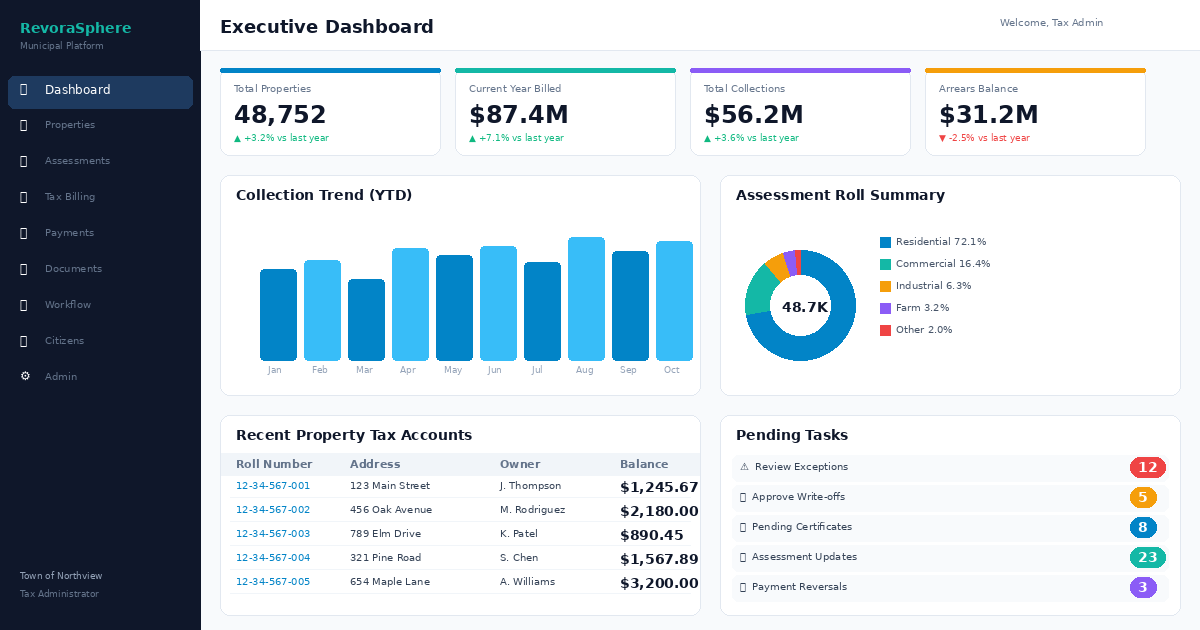
Analytics as infrastructure. Data visibility is not a reporting module that runs nightly batch jobs. Next-generation platforms provide real-time dashboards that update as transactions post, with native integration into the analytics tools municipal leadership is already using.
RevoraSphere is built to these specifications — with a dedicated environment per municipality.
The Role of AI and Intelligent Automation
The next frontier in municipal platform development is the integration of AI capabilities into core revenue management workflows. RevoraSphere's AI and intelligence layer (planned) is designed to add several capabilities to the platform:
- Anomaly detection in utility consumption data — identifying potential meter errors, leaks and unusual usage patterns before they result in billing disputes
- Delinquency prediction — flagging accounts at risk of falling into arrears before the payment due date, enabling proactive outreach
- Rate scenario modelling — using historical consumption data to project the revenue impact of proposed rate changes before council adoption
- Document classification — routing exemption applications to the correct review workflow based on document content
These capabilities are natural extensions of a unified platform — they are only possible because all the relevant data lives in one place.
Implications for Municipal Leadership
For CAOs, CFOs and IT directors at Canadian municipalities, the transition to next-generation GovTech has three practical implications.
The cost of waiting is rising. Legacy systems are becoming more expensive to maintain, not less. Each year a municipality delays modernization is a year of increased maintenance fees, increased reconciliation overhead and accumulated technical debt. The switching cost of modernization does not get lower over time.
Phased modernization is possible and advisable. The risk of wholesale system replacement can be managed through phased implementation. Municipalities do not need to replace everything at once. Starting with the highest-pain module — and validating it completely before extending to others — achieves operational improvements immediately while managing implementation risk.
The platform choice matters more than the implementation timeline. A well-designed platform that is correctly implemented delivers value for fifteen or twenty years. Choosing a platform on the basis of lowest upfront cost, without evaluating architectural quality and long-term cost of ownership, is a strategic error that is easy to make and hard to unwind.
Evaluating Municipal Platforms
When evaluating municipal technology platforms, ask vendors to demonstrate: (1) a unified account view across property tax and utilities, (2) year-end reconciliation as a reporting exercise rather than a project, (3) a citizen portal designed and validated against WCAG 2.2 AA accessibility criteria, and (4) a real-time collections dashboard. A platform that cannot demonstrate these is carrying legacy architecture, whatever its interface looks like.
RevoraSphere's Position in the Evolving Landscape
RevoraSphere is not competing to be the best property tax software or the best utility billing product. Those are legacy categories. RevoraSphere is built as a unified municipal operations platform for Canadian municipalities — a category that did not exist until recently.
This positioning reflects an architectural distinction. RevoraSphere is not a collection of modules that share a common vendor. It is a platform built with a unified data model, a shared AR ledger and an architecture designed around the municipal revenue lifecycle from the start.
That architectural distinction is the source of the operational advantages RevoraSphere is designed to deliver: simpler reconciliation, stronger collections practices, better citizen experience and stronger analytics.
The Canadian GovTech market is large, underserved and in transition. The municipalities that modernize on the right platform in the next few years will build operational advantages that compound over time — in service quality, financial efficiency and organizational capacity.
Assess your current state
Map your existing revenue systems, identify reconciliation overhead and understand the true annual cost of the status quo — staff time, vendor fees and consultant costs.
Define your modernization priorities
Identify which operational pain point — reconciliation, citizen service, real-time visibility, collections — delivers the highest value if resolved first.
Evaluate platforms on architecture, not features
Compare platforms on unified data model, cloud-native architecture, alignment with Canadian privacy legislation, and open API connectivity — not on feature lists that legacy vendors have had decades to pad.
Start with a focused first module
Implement a single module with a parallel-run validation approach. Demonstrate value, build organizational confidence and establish the data foundation for subsequent modules.
Extend and scale
Add modules in sequence, each validated against the previous one. Module by module, the municipality moves onto a fully unified platform with full historical data.
Conclusion
The future of Canadian GovTech is unified. The fragmented legacy architecture that has dominated municipal technology for two decades is being replaced by cloud-native platforms that treat municipalities as integrated organizations — not collections of departments with separate data systems.
Municipalities that recognize this transition and act on it are building operational capabilities that will define their service quality and financial performance for the next decade. Those that wait are paying an escalating cost in maintenance fees, staff overhead and citizen experience quality for the privilege of staying with what they know.
RevoraSphere is built for the municipalities that are ready to lead this transition.
See RevoraSphere in Action
Purpose-built for Canadian municipalities. Property tax, utility billing, citizen portal, and analytics — unified.