The State of Municipal Billing in Canada
Walk into the finance department of many small or mid-sized Canadian municipalities and you will find something remarkable: a team of dedicated, highly competent people doing complex financial work using tools that belong in a different era.
Property tax bills are generated by a system that has not been substantially updated since the mid-2000s. Utility bills go out from a separate platform that requires manual uploads of meter reads. Payment processing involves a cashiering terminal that does not talk to either billing system. Year-end reconciliation is a ten-step spreadsheet process that a single person knows how to run.
These are not edge cases. This is a common picture of municipal revenue operations in Canada — not because of poor management or lack of ambition, but because the technology available to municipalities has not kept pace with the complexity of what municipalities are asked to do.
RevoraSphere was built to change this.
Year-end reconciliation that consumes days in fragmented environments becomes a report on a unified ledger.
Before RevoraSphere: The Legacy State
To understand what RevoraSphere delivers, it helps to start with a detailed picture of the operational reality it replaces.
The Property Tax Workflow (Legacy)
The property tax cycle in a legacy environment often looks like this:
Receive the assessment data file
Finance staff download the MPAC assessment file, manually import it into the tax system, and reconcile changes against the prior-year roll.
Calculate levy and generate bills
The tax system applies mill rates to assessment values. Bills are generated as a print-ready file and sent to a third-party mail house.
Process payments manually
Payments received by mail are entered manually. Counter payments are processed in a separate cashiering terminal. Online payments (if available) sync nightly.
Handle inquiries with incomplete data
Service staff answer account inquiries using the tax system but cannot see utility balances or payment history from other modules.
Year-end reconciliation
Finance manually reconciles the tax system AR with cashiering records, payment processor reports and GL postings. This can consume days of finance-team effort.
Every step in this workflow has manual touchpoints, and every manual touchpoint is a source of errors, delays and staff time cost.
The Utility Billing Workflow (Legacy)
The utility billing cycle adds another layer of manual complexity:
- Meter reads are collected (AMR or manual) and imported via CSV into the billing system
- Consumption is calculated and bills are generated
- Bills are printed and mailed separately from property tax bills (different vendor, different mailing)
- Payments are processed through the same cashiering terminal but posted to a different module
- Citizens who call about their account see two separate account numbers — one for tax, one for utilities
The separation between property tax and utility billing means that a citizen with a property tax arrear and a utility credit has no offset mechanism — even though both balances belong to the same person at the same address.
After RevoraSphere: The Unified State
The transformation that RevoraSphere delivers is not incremental. It is architectural.
When a municipality implements RevoraSphere, the fragmented workflows described above are replaced by a unified process that flows through a single platform.
What Changes for Finance Staff
For the finance team, the most immediate change is the elimination of reconciliation as a workflow.
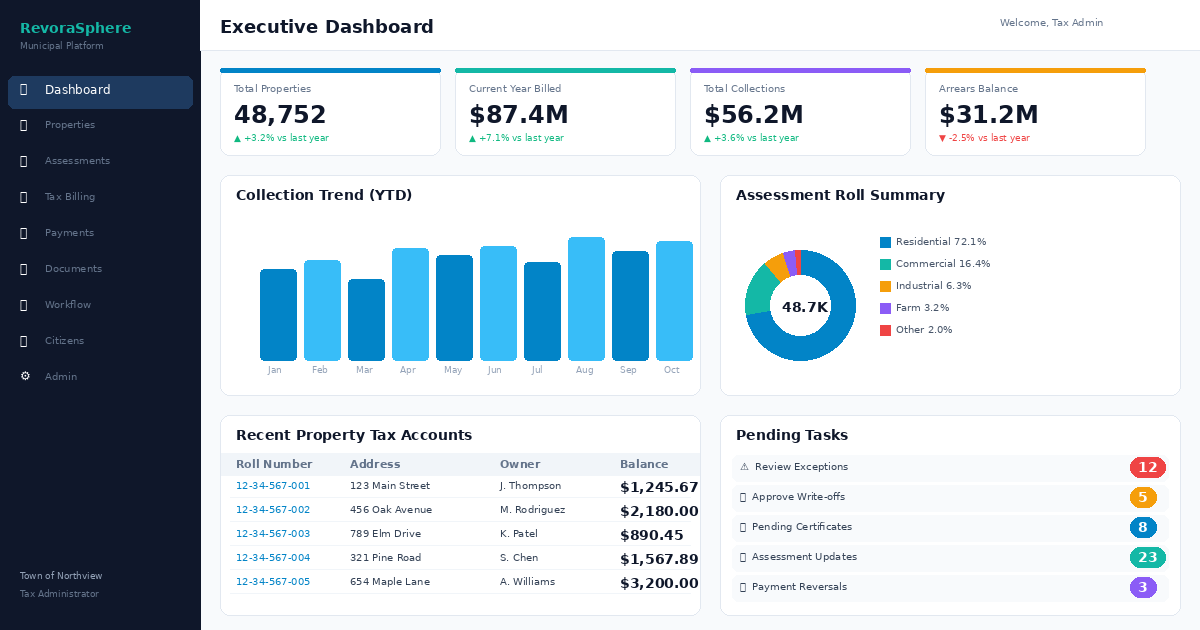
In RevoraSphere, property tax payments, utility payments and any other revenue type all post to the same AR ledger. There is no reconciliation between modules because there are no module boundaries in the AR layer. Year-end close becomes a matter of running final reports, not a multi-day reconciliation exercise.
Rate structure changes — new utility rates, tax rate bylaw updates, penalty schedule changes — are configured in the administration layer and take effect without software updates or vendor involvement.
The analytics dashboard gives the finance director a real-time view of levy realization, AR aging and collections rate without manual report generation.
What Changes for Citizens
The citizen experience transformation is perhaps the most visible operational improvement.
In the legacy environment, a citizen who wants to pay their property tax bill online and check their utility balance needs to visit two different websites (if online access exists at all), log in with two different credentials, and manage two separate payment accounts.
In RevoraSphere, a single citizen portal login shows the complete account: property tax balance, utility balance, any other outstanding charges, and payment history across revenue types. The citizen can pay any or all outstanding balances in a single transaction, enrol in PAD for automated payments on any revenue type, view their utility consumption history and download statements.
The portal is accessible on any device, designed with WCAG 2.2 AA principles in mind — with formal accessibility validation performed during implementation and release readiness — and available around the clock.
Designed to Support Collections
When paying is easy and citizens can see their complete balance, more citizens pay before the arrear date. Unified self-service is a collections tool as much as a service tool.
What Changes for Service Representatives
Service representatives answering citizen inquiries benefit from the unified account model as much as citizens do.
In the legacy environment, answering a question like "What is my total balance?" requires navigating between two or three systems, translating account numbers and manually adding up figures. A short call becomes a long one.
In RevoraSphere, a single account search returns the complete account picture: outstanding balances, payment history, exemption status, utility consumption anomalies and any open service requests. The representative can process payments, set up payment arrangements and update account information — all from a single interface.
The Transition: Managing Implementation Risk
The first question municipalities ask about platform modernization is about risk. Replacing core billing infrastructure is not trivial. What if something goes wrong during cutover?
RevoraSphere's implementation methodology is designed around a parallel-run validation approach that reduces cutover risk.
- Full cutover on a single date across all modules
- No validation period against the legacy system
- Problems discovered in production
- Citizen and staff impact if issues arise at go-live
- No rollback path once the legacy system is decommissioned
- Module-by-module implementation with independent validation
- A parallel run for a full billing cycle before each cutover
- Issues found and resolved before any module goes live
- Citizen experience improved incrementally rather than all at once
- The legacy system remains available until each module is validated
- A standard migration methodology that is not municipal-specific
- Generic data migration tools not designed for tax and utility data
- Integration testing that does not account for municipal workflow specifics
- Support teams unfamiliar with assessment data formats or PAD requirements
The phased approach means a municipality can start with the module that represents its highest immediate pain point — typically property tax or utility billing — validate it completely, and then extend to additional modules with confidence built from the first phase.
The Cost Picture: Legacy vs RevoraSphere
The financial case for platform modernization is often obscured by the visible cost of a new system compared with the less visible cost of maintaining an old one. For many municipalities, a subscription platform compares favourably against the combined cost of maintaining, upgrading and reconciling multiple legacy systems.
Conclusion
The transformation from paper-first, fragmented billing to unified digital revenue management is not a technology project. It is an operational transformation that changes how finance staff work, how citizens interact with their municipality, and how leadership makes decisions.
RevoraSphere is designed to make this transformation possible for Canadian municipalities of all sizes — without betting the revenue operation on a big-bang replacement project.
If your municipality is ready to understand what this transformation would look like in your specific context, a platform demonstration built around your operational scenario is the place to start.
See RevoraSphere in Action
Purpose-built for Canadian municipalities. Property tax, utility billing, citizen portal, and analytics — unified.